Blinds for Tilt-and-Turn Patio Doors in Calgary: Fit, Handles and Opening Clearance
You found the perfect blind, and then realised your patio door handle is right in the way. Tilt-and-turn doors open differently from sliding or standard hinged doors, and that changes everything about how a blind needs to fit. This blog walks through what to check before ordering: how the door moves, where the clearances are, and what questions to ask before anything gets mounted.
Identify How the Door Tilts and Swings
Before measuring anything, understand what kind of door you're working with because tilt-and-turn doors behave differently depending on the handle position.
Two distinct opening modes:
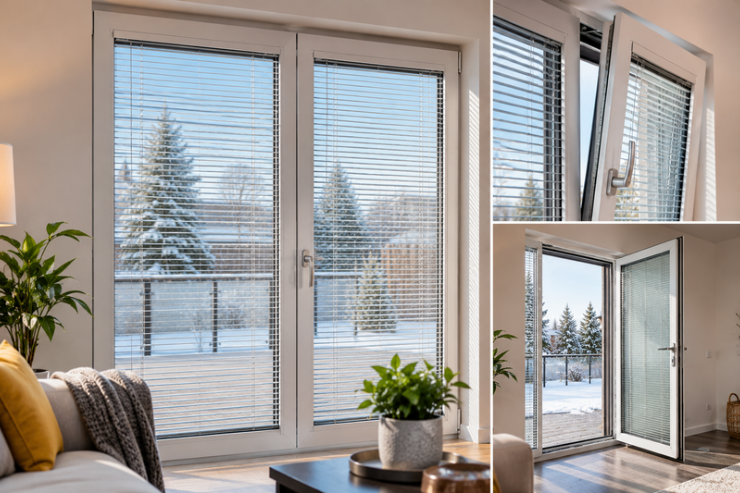
- Tilt mode: the top of the door tilts inward while the bottom stays fixed. Used for ventilation
- Turn mode: the entire door swings inward on a side hinge, like a standard casement door
Both modes require the blind to either stay completely clear or move with the door. A blind that works in tilt mode may obstruct turn mode entirely if the clearance isn't checked for both.
Also confirm:
- Whether the door has single or double glass panels
- Which side the hinge sits on
- Where the handle is positioned: centre, mid-height, or lower
This information shapes every decision that follows.
Check the Handle and Frame Clearances
The handle on a tilt-and-turn door typically projects outward from the glass face, and that projection is the first clearance to measure.
What to record:
| Measurement | Why It Matters |
| Handle projection depth | Determines how much space any blind needs behind it |
| Usable frame depth | How much mounting depth the frame actually offers |
| Hinge placement | Affects where a blind can be fixed without interference |
| Seal and gasket position | Fixing points must avoid compression seals |
| Frame material | Aluminium, uPVC and timber each accept fixings differently |
A blind mounted too close to the glass will catch on the handle every time the door moves. Too far out and it may protrude into the room further than expected. Both are worth testing before ordering.
Test the Proposed Blind Against Both Opening Modes
This is where most installation problems with blinds for tilt-and-turn patio doors originate; the blind is measured for one mode and obstructs the other.
For tilt mode:
- When the top of the door tilts inward, the upper portion of the glass moves toward the room
- Any blind sitting close to the glass at the top must have enough clearance not to catch on this movement
- Measure how far the top of the glass travels inward when fully tilted
For turn mode:
- The entire door swings inward; this is a much larger movement
- The blind needs to either be completely clear of the door's swing path or be mounted to move with it
- Check how much wall space is available beside the door for the door to swing into without hitting furniture or the blind's side stack
Running through both modes physically with a tape measure tracking the glass edge movement is the most reliable way to confirm whether a proposed blind will work in practice.
Door-Mounted vs. Surround-Mounted Options
There are two broad approaches to covering a tilt-and-turn door. Here’s how they compare across every factor that matters:
| Factor | Door-Mounted | Surround-Mounted |
| How it’s fixed | Directly to the door frame or glass | To the wall or window reveal around the door |
| Moves with the door | Yes, travels with the door when it opens | No, stays fixed while the door moves |
| Best for | Limited wall space around the door | Wider openings with clear wall space on either side |
| Turn mode clearance | Not an issue, blind moves with the door | Door must swing fully clear of the blind |
| Installation | Requires frame-compatible fixing points | Easier to install and adjust independently |
| Frame compatibility | Must match door manufacturer’s specifications | Standard wall or reveal fixing, more flexible |
| Door warranty risk | Drilling into frame may affect warranty | Lower risk, fixed to surrounding wall instead |
| Removal | Involves the door directly | Independent of the door, simpler to remove |
Neither option is universally better; the right choice depends on the specific door, the room layout, and how the door is used daily.
Preserve Privacy and Access in Daily Use
Once the clearance questions are resolved, fabric choice becomes the next practical decision.
For tilt-and-turn patio doors, consider:
- Opacity: doors face outward, often toward a garden, patio, or shared space. Evening visibility from outside is a real consideration. A light-filtering fabric that works well during the day may offer less privacy after dark
- Controls: the operating chain, rod, or motor control needs to remain reachable without reaching past the door handle or across the swing path
- Weight: heavier fabric on a door-mounted blind adds load to the door frame fixing points. Lighter fabrics are generally more suitable for door-mounted applications
A fabric sample viewed against the actual door, in both natural and artificial light, is the most reliable way to assess opacity before ordering.
Confirm the Installation Details Before Ordering
Ordering before confirming the installation method is the most common and most costly mistake with specialty door blinds.
Before placing any order, confirm:
- Whether the door manufacturer approves fixing into the frame; some warranties are voided by drilling
- Which mounting locations are structurally sound on your specific frame material
- Whether a door-specific measurement checklist has been completed; not a standard window measurement
- What hardware is included and whether it suits the frame depth available
- Whether the installer has assessed both opening modes physically, not just on paper
A site assessment specific to the door, rather than a general window covering quote, is the right starting point for tilt-and-turn installations.
Request a Tilt-and-Turn Door Fitting Assessment From Sun Blinds YYC
Choosing blinds for tilt-and-turn patio doors is a fitting problem before it's a product decision. The handle position, the frame depth, the swing clearance, and the door manufacturer's own fixing guidance all need to be confirmed before a blind is selected, let alone ordered.
Work through the clearances methodically, test both opening modes, and get a door-specific assessment before committing to a product or mounting method.
Sun Blinds YYC offers in-home consultations for specialty door applications across Calgary. Book an assessment to have your tilt-and-turn door measured properly, both modes, both clearances, before anything is ordered.
The right blind starts with understanding the door.
FAQs
Q1: Will a standard roller blind suit every tilt-and-turn patio door?
Not automatically. Standard rollers need clearance checks for both tilt and turn modes. Handle projection and frame depth must be confirmed before a standard roller is ordered.
Q2: Can a blind be mounted to move with the door when it opens?
Yes, door-mounted blinds travel with the door. The frame material and door manufacturer's guidelines determine whether this fixing method is suitable for your specific door.
Q3: Should the door frame be drilled before checking the door warranty?
No. Some tilt-and-turn door warranties are affected by drilling into the frame. Always check the manufacturer's documentation or contact the door supplier before any fixing work begins.
Q4: What fabric opacity works best for a patio-facing tilt-and-turn door?
A mid-range opacity fabric handles daytime glare well. For evening privacy, a higher-opacity or blackout option is worth considering, especially for doors facing shared outdoor spaces.
Q5: Is a tilt-and-turn door measured the same way as a standard window?
No. A door-specific measurement accounts for handle projection, both opening modes, hinge side clearance, and frame fixing points, all of which a standard window measurement does not cover.