
Why Are Canadians Pairing Curtains With Blinds Now? Find Out
You finally picked the perfect blinds and something still feels off. The window looks bare, the room lacks warmth, and you can't quite explain why.
Turns out, millions of Canadians are solving this exact problem by layering curtains over their blinds. It's not just a design trend but a practical upgrade that changes how a room feels, functions, and looks.
The Layering Trend Taking Over Canadian Homes
Walk through any renovated Canadian home right now and you'll notice something different about the windows; there's a blind doing its job, and curtains framing the whole thing like the room's finishing touch.
It's not a new idea, but it's having a real moment. Here's why it's catching on:
- Search interest in pairing curtains with blinds in Edmonton and across Canada has grown steadily over the past two years
- Home renovation content on social platforms is filled with before-and-afters where the single biggest change is a curtain panel added over an existing blind
- Blinds and curtains solve different problems, so when you use both, you stop compromising on either one
Two Layers, Two Different Jobs
Blinds are functional by design. They control light, offer privacy, and keep things clean and minimal. And curtains add softness, height, or warmth to a room.
| What Blinds Do Well | What Curtains Add |
| Light control | Visual warmth and softness |
| Privacy | Height and drama |
| Clean, minimal look | Texture and layered depth |
| Easy daily operation | Sound absorption |
| Moisture resistance | Colour and personality |
When windows and blinds work alone, a room can feel finished but flat. Curtains bring the kind of softness that makes a space feel lived-in, without touching a single piece of furniture.
Curtains Over Roller Shades: Why It Works
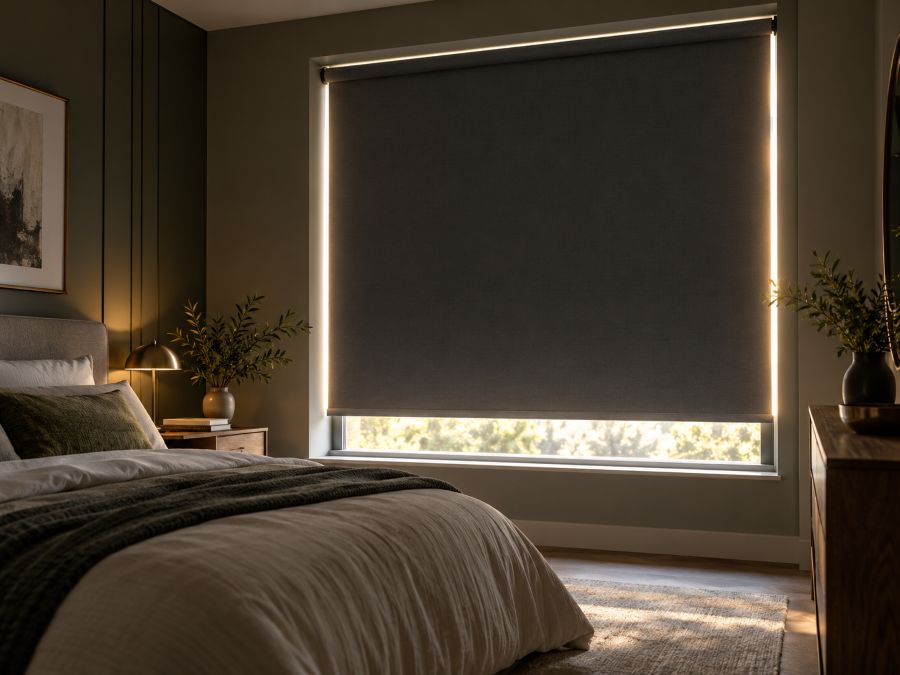
Roller blinds in Edmonton are one of the most popular window covering choices and for good reason. They're sleek, available in a wide range of fabrics, easy to operate, and suit almost any room.
Pairing curtains over a roller shade is the most common layering combination right now and it works because the two elements don't compete.
Why this pairing works so well:
- The roller sits flush to the window and the curtain hangs freely without interfering
- The roller handles light filtering or blackout when you need it, privacy at the pull of a chain whereas the curtain frames the window, adds colour or texture, and makes the ceiling feel taller when hung high
- You can keep the curtains open daily and use the roller for light control
- It works in living rooms, bedrooms, and even home offices
- The combination reads as intentional, not overdone
Layering Curtains With Zebra Blinds
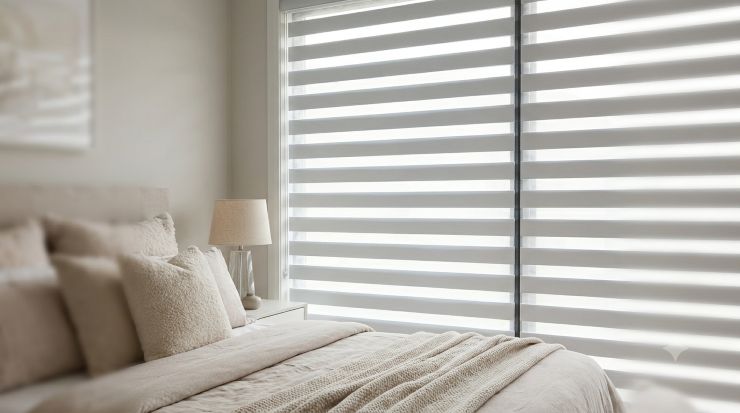
Zebra blinds in Edmonton already do more than most blinds visually; alternating sheer and solid bands that shift light beautifully throughout the day. When curtains are added here, the goal is framing, not filling a gap.
What to keep in mind with this pairing:
- Choose a curtain that's lighter in visual weight than the zebra blind
- Let the zebra handle light control and the curtain plays a decorative role here
- Avoid heavy blackout curtains over a zebra blind as it cancels out the sheer effect
- Sheer curtain panels work especially well for a softer, more layered feel
- Keep the curtain fabric simple, such as, a solid linen or cotton that doesn't compete with the pattern movement of the zebra
Getting the Proportions Right
This is where most people go wrong; not in choosing the wrong products, but in hanging things in the wrong place.
Four things that make the biggest difference:
- Rod height: Mount as close to the ceiling as possible, not just above the window frame. High rods make ceilings feel taller and windows feel larger
- Curtain drop: Let the curtain graze the floor or sit half an inch above it. Curtains that end at the sill make the room feel smaller
- Panel width: Extend panels 15 to 30 cm past the window frame on each side so the window looks wide and generous
- Blind position: Inside or outside mount, completely independent of the curtain rod — the two systems don't interfere
Quick reference:
| Element | Recommended Position |
| Rod height | 10–15 cm below the ceiling |
| Curtain drop | Floor-length or just grazing |
| Panel width | 15–30 cm past window on each side |
| Blind position | Inside or outside mount, independent of curtain rod |
Pairings That Canadians Love Right Now
There is no universally correct combination. The right pairing depends on the room, the light, and what you want the space to feel like.
Here's what's resonating most across Canadian homes right now:
| Blind Type | Curtain Pairing | Best Room |
| Zebra blinds | Sheer or light linen panels | Living room, bedroom |
| Roller shades | Linen or cotton drapes | Any room |
| Blackout roller blinds | Velvet or heavy cotton | Bedroom |
| Light-filtering roller | Casual cotton panels | Kitchen, dining area |
| Honeycomb blinds | Neutral sheers | Bedroom, exterior rooms |
Find The Right Layer For Your Windows
The curtain-and-blind combination isn't about following a trend, it's about giving your windows the chance to do more than one thing at once. More warmth. More control. More personality.
If you've been looking at your windows and feeling like something is missing, this might be exactly what that something is. Start with one room, see how the layering changes the feel and continue from there.
Sun Blinds Inc. carries a wide range of window blinds in Edmonton, including zebra blinds and roller blinds, that pair well with curtains across every room type. Browse the options or book a free in-home consultation to see the combinations in your own light.
FAQs
Q1: Do curtains and blinds together look too heavy or cluttered?
Not when proportions are right. Keep curtain fabric simple and lightweight if your blind already has texture or pattern. The key is to contrast one element functional, one decorative.
Q2: Which rooms suit the curtain-and-blind combo best?
Living rooms and bedrooms benefit most. Bathrooms and kitchens are better with blinds alone; moisture and steam make curtain maintenance difficult in those spaces.
Q3: Can I use blackout curtains over zebra blinds?
You can, but it works against the zebra blind's purpose. If full blackout is the goal, a blackout roller blind with sheer curtain panels is a more practical and better-looking combination.
Q4: Does layering curtains with blinds make the room darker overall?
Only if you choose blackout fabrics for both. Light-filtering blinds paired with sheer curtains actually diffuse light beautifully and the room feels softer, not darker.
Q5: Is it expensive to layer curtains over existing blinds?
Not necessarily. If the blinds are already in place, adding a curtain rod and two panels is a relatively low-cost change. The visual impact is disproportionately large compared to the spend.